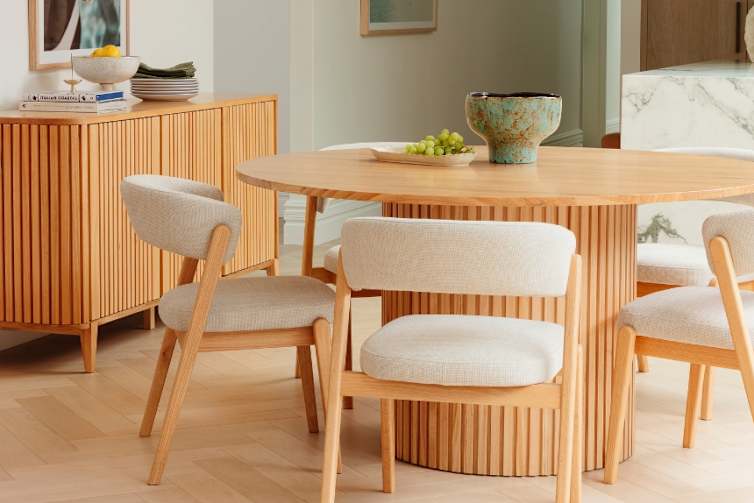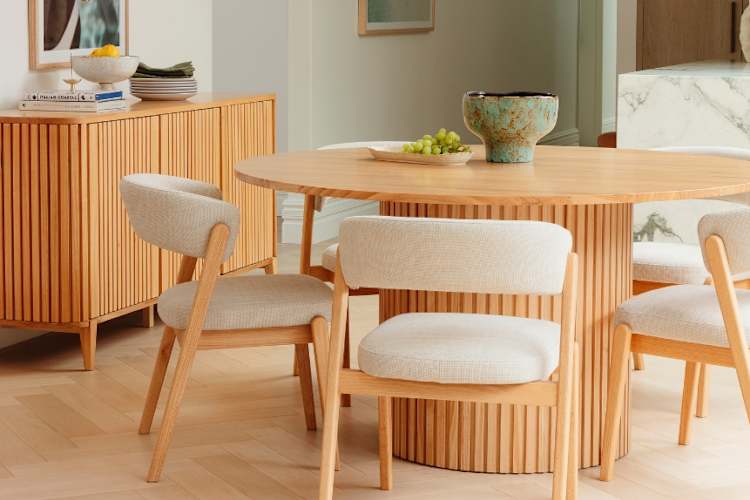
Advice

August 28, 2026

By: Zara Sahota

Dining Table Size Guide: What Size Seats 6, 8, 10?

The dining table is where everyday meals turn into long conversations, quick breakfasts become family rituals and special occasions bring everyone together. Finding the right size means creating enough room for all of those moments, without overwhelming your space. 

From comfortable 6-seaters to generous tables for 8, 10 or more, this dining table size guide covers everything you need to know before choosing your table. 

As a general rule, allow around 60cm of table space per person and approximately 90–100cm of clearance around your dining table for chairs and movement. For rectangular tables, a 6-seater will generally start around 150–180cm long, while larger 8- and 10-seater tables need progressively more room. 


Quick dining table size guide: 

Seats 

Approx. rectangular table length 

4 people 

120–140cm 

6 people 

150–180cm 

8 people 

200–240cm 

10 people 

240–300cm+ 


How much space does each diner need?


Allow approximately 60cm of table edge per person for comfortable everyday dining.

This gives each diner enough room for a chair and place setting without the table feeling crowded. For more generous dining, especially with wider or upholstered dining chairs, allowing closer to 65–70cm per person can feel more comfortable. 

Also consider: 

  • The width of your dining chairs 

  • Whether chairs have arms 

  • Table leg or pedestal placement 

  • Space for serving dishes in the centre 

  • Whether you regularly add extra guests 


A table may technically fit six chairs, for example, but chunky corner legs or especially wide chairs can reduce the usable seating space.

20.jpg20.jpg

Room size to table size: how much clearance do you need?


Aim for at least 90cm between the edge of your dining table and nearby walls or furniture. 

This gives you enough space to pull out a chair and move behind someone who is seated. Around 100–120cm can feel even more comfortable in larger dining areas or high-traffic spaces. 

If there is a buffet or sideboard behind the table, measure your clearance from the front edge of that piece rather than from the wall, and make sure you can open the doors or drawers for storage.

21.jpg21.jpg

Dining table and room size guide 

Table size 

Approx. minimum dining zone with 90cm clearance 

120 x 90cm 

300 x 270cm 

150 x 90cm 

330 x 270cm 

180 x 100cm 

360 x 280cm 

210 x 100cm 

390 x 280cm 

240 x 100cm 

420 x 280cm 

300 x 110cm 

480 x 290cm 


These measurements provide a useful starting point, but your room layout and surrounding furniture should always be considered. 

Seating capacity by shape: round, oval or rectangular? 


The shape of your table influences both seating capacity and how it fits within the room.

Rectangular dining tables 

Rectangular tables are particularly practical for larger households and longer dining rooms. 

As a general guide: 

  • 150cm: 4-6 people 

  • 180cm: 6-8 people 

  • 210cm: 6-8 people 

  • 240cm: 8-10 people 

They also make it easy to place additional chairs at either end when space allows. 

22.jpg22.jpg
23.jpg23.jpg

Round dining tables 

Round tables encourage conversation and can work particularly well in square or compact dining spaces. 

As a rough guide: 

  • 100–120cm diameter: 4 people 

  • 130cm diameter: 4–6 people 

  • 150cm diameter: 6–8 people 

Very large round tables can become less practical as reaching across the centre becomes more difficult.

Oval dining tables 

Oval tables offer similar seating capacity to rectangular tables but with softer edges. 

Their curved ends can make circulation feel easier in narrower dining spaces and may provide a little more flexibility when adding an extra chair.

24.jpg24.jpg

When should you choose an extension dining table?

25.jpg25.jpg

An extension dining table lets you keep the footprint more compact day to day while creating extra seating when family and friends arrive. 

An extension table can be especially useful if: 

  • You entertain regularly 

  • Your dining space is compact 

  • You only occasionally need 8–10 seats 

  • Your household size changes 

  • You want more flexibility in an open-plan room 

Measuring your dining space step-by-step 


The easiest way to find the right table size is to work backwards from your available room dimensions. 


  1. Measure the dining area. Record the usable length and width.
  2. Account for surrounding furniture. Include buffets, sideboardscabinetry and anything else projecting into the room.
  3. Allow for clearance. Aim for around 90cm between the table and surrounding walls or furniture.
  4. Calculate your maximum table size. Subtract approximately 180cm from both the usable room length and width as a starting point.
  5. Mark it on the floor. Use painter’s tape to map out the tabletop dimensions.
  6. Factor in chair size. Consider the width and depth of your chosen dining chairs, particularly upholstered or armchair-style designs.
  7. Check walkways. Make sure key paths through the dining or open-plan area remain clear. 


If you plan to place a rug beneath the table, make sure it is large enough for the chairs to remain on the rug when pulled out. See our rug size guide for more guidance. 

Recommended OZ tables by seat count 

For around 6 seats 

Look at tables around the 150–180cm mark. 

The Charles Dining Table 180cm is a useful example for a six-seat dining space, while the Avoca Dining Table 150cm offers a smaller Australian Messmate option. 


For around 8 seats 

Look towards tables around 200–240cm, depending on chair and leg size. 

The Como Dining Table 220cm and Melba Dining Table 210cm sit within this larger dining-table category and are well suited to spaces where more generous seating is required.


For flexible 6–10+ seating 

An extension table gives you the greatest versatility. 

The Bari Extension Dining Table is available in versions extending from 140–200cm and 190–290cm, while the Mango Creek Extension Dining Table extends from 210–310cm for larger gatherings. 


Always check the individual table dimensions, chair width and leg placement before deciding on your final seating capacity. 

Frequently Asked Questions

Dining table sizes vary by shape and design, but common rectangular sizes include approximately: 

  • 120–140cm for four people 

  • 150–180cm for six 

  • 200–240cm for eight 

  • 240–300cm or more for ten 

Allow around 60cm of table edge per diner as a useful starting point. 

There is no single standard Australian dining table size, but 150–180cm long is a common range for a six-seater rectangular table. 

Larger family or entertaining tables commonly sit around 200–240cm or more. The best size ultimately depends on your room and household rather than an average measurement. 

A 120cm dining table is not too small if it suits your room and household. 

A 120cm rectangular table generally suits around four people, while a 120cm round table can also work comfortably for four. If you regularly seat six people, a larger table will usually feel more comfortable. 

A rectangular 6-seater dining table should generally be around 150–180cm long. 

Allow approximately 60cm per diner and check the position of the table legs and width of your chairs before buying. 

Start with one simple focal point and build around it. 

Try: 

  • A sculptural vase 

  • Fresh greenery or florals 

  • A decorative bowl 

  • Candles in varied heights 

  • A simple table runner 

  • A small grouping of two or three objects 

Keep everyday styling low enough that it does not interrupt conversation across the table.